
Saturday, March 16, 2024

Friday, March 15, 2024

Sunday, March 3, 2024
Andrea's Fall Quilt

OOPS
( or Fall, Falling, Fallen! )
11"-ish x 14"
Hand-dyed and commercial cotton
Anytime I can use shoes in a quilt or art project I will. Not really wanting to make the season of Fall my focus, I went with a tongue-in-cheek ( or dark, think Agatha Christie or Hitchcock! ) interpretation, where a pair of shoes could represent someone who has taken a fall! Slipped on a wet leaf perhaps? Or maybe the person is sitting and watching the fall leaves flutter in the wind?
Friday, March 1, 2024
Karen's Fall
Bare Tree 111

The tree is constructed with many different strips of brown batik which I heavily stitched in place.
The leaves were made from double sided batik. I stitch the veins in with smoke colored monofilament thread. I let them curl and stitched them onto the back ground in just a few spots
so they would keep the curl.
The back ground was a perfect commercial fabric that I strategically quilted.
This is an old piece that I pulled out and added the fallen leaves to the bottom of the tree.
Added more quilting in the ground.
It's nice to revisit old pieces!!
Tricia's Fall Scalloping
Fall Scalloping

Last month I used a tree and leaves for my ancestry so I struggled with a new idea for fall. As I usually do when I'm stuck, I ask a family member for suggestions on the theme word. My daughter's first reaction was we always go scalloping in the fall. On Nantucket Family Scalloping opens on October 1st.
Scalloping on Nantucket is a treasured tradition for families but also the commercial fisherman. These are the sweetest and tiniest bay scallops. The bay scalloping industry is dying everywhere. Nantucket has put a huge investment into saving and keeping the industry. This past year the investment has been paying off. The amount of scallops that are being harvested and seed that is in the harbor has increased. We have reason to be hopeful for the continuation of the bay scallop in Nantucket Habor.
Now to my journal quilt. I find it difficult to portray people and especially faces in my work. The first weekend in December our friend Nick and his family came to Nantucket for the Christmas Stroll. (so technically not fall). I had mentioned to Nick that Nantucketers very often go scalloping on Thanksgiving morning to have a scallop dish for Thanksgiving. It was the first weekend in December and Nick said lets go! He put on our wet suit and went out to Jackson Point. My quilt is from a picture of Nick coming in with a basket of scallops. Even after a hot shower he was cold for a long time! We enjoyed a delicious scallop dinner that night.
I printed the photograph on fabric, free motion stitched the grasses, created the basket from wire and filled with real tiny scallops shells that I have collected over the years. The scallops rake was made from tulle, metal and a dowel. It is 10"wide x 13"high
Wednesday, February 28, 2024
Nedra's Fall - Vermont Gems

Vermont Gems
Raw edge applique, hand painted, commercial cottons, machine quilted
12' X 12"
I moved to Vermont in 1979 and was thrilled to experience many "firsts" there. Some of these included seeing many feet of snow, below zero temperature, snow skiing, sugar on snow parties, snow shoveling and of course Fall Leaf Peeping!! The colorful leaves looked like gems on the branches to me after having seen little more than brown leaves in Louisiana.
I choose to spotlight the leaves and their glorious hues in this piece. I hand painted most of the fabric. I did use one commercial batik for the sweet gum leaves but dabbled a bit of paint on those. The leaves are machine stitched onto the background. The larger ones that extend beyond the edges are double sided and 3 dimensional. I used a commercial fabric for the background and scattered them over it to look like they were on the ground in the woods.
Wednesday, November 1, 2023
Tricia's Ancestry
Tricia's Family Tree

In thinking about our word "Ancestry", I kept going back to the image of a favorite photograph that I have from my grandparent's backyard. We would travel to our grandparents' house for holidays. Someone would photograph the grandchildren in the tree in the back yard. I am the girl with dark jumper sitting in the middle but at the back.

I have two ancestry books on my father's family - The Purrington's. I have never really read the books before. This project gave me the incentive to read through them. What I learned was that the Purrington's were from the town of Puddington, England (near Tiverton). When my ancestors came to the US, their name was changed from Puddington to some form of Purrington -- some spelled it with two R's, some with one R, some with a G, and some without the G. The different family members landed in different parts of the country. My father's family ended up in Western Massachusetts in a tiny town named Haydenville. This is where my grandparents house was with the tree behind it.
I decided to create my family tree with the eight branches of my father's family. My father, Wilbur Purrington, was the youngest of eight children. On the trunk of the tree the two large leaves represent my grandparents, Wilbur and Eleanor Purrington. On the branches are leaves that represent all their children and families. The pointy leaves are males and the rounded ones are females. Starting from the left the branches have leaves for the parents, (and their children):
Frankin Purrington and Ruth, (Edwin, Frankin Jr.)
Alden Purrington and Marjorie, (Eleanor, Barbara, Alden Jr.)
Donald Purrington and Polly, (Jack and Jean)
Rollo Purrington and Marion, (Barry, Bruce and Richard)
Esther Purrinton and Chet, (Neil and Eleanor)
Philip Purrington and Ann, (Katharine and Nancy)
Wilbur Purrington and Patricia, (Robert, Sarah and Tricia (me))
The small green leaf on the left is for Helen Purrington who died at the age of 2
I used fusibles with my fabrics and free-motioned the quilting.
Tuesday, October 31, 2023
Andrea's Ancestry Quilt

Ancestors: Relatively Speaking
11" x 14"
linen, cotton, stencil, silk screen, beads
Scotland, Sweden, Denmark, Ireland, England, Belgium, Germany, France, Mali, Norway and Wales. These are the countries of my ancestors, according to Ancestry dot com. Red, white, blue, yellow, green, gold & black are the common flag colors for these countries and most of the flag designs are striped.
I'm always fascinated with where the creative process / ideas start and where they end up.
The original starting point for this quilt was a background of solid fabrics in the flag colors with abstracted figures representing my ancestors. I cut a stencil for the figures and then fused together horizontal 'flag' fabrics. I stenciled the the figures on to the fabric, but to my disappointment, it looked dirty, especially on the yellow fabric. Next I tried stenciling on pale grey linen, starting at the bottom with black fabric paint and proceeding up towards the top with lighter shades of grey. That was better, but a bit depressing! It needed color and because my favorite is purple I decided to stencil a few single figures in purple on top of the black & grey figures. Better, but it still needed more color. At that point, a narrative started in my head that my love of purple, black & white, bright colors, dots, checks and stripes must be part of my DNA, handed down from my ancestors, so I cut 5 figure shapes out of some of my favorite fabrics. Playing with their placement was fun and it seemed like they belonged. As a nod to my great grandfather, I screen printed the purple figure from a 1906 letter written by him in Swedish.
Sunday, August 27, 2023

Sunday, July 30, 2023
Alice's Luminosity Quilt: St. Louis Arch at Night

A friend from Missouri posted on Facebook a photo of the St. Louis arch taken by a professional photographer. I immediately thought of basing my luminosity quilt on this photo. I contacted the photographer (Larry the Photographer) for permission to use his image in this way, and he graciously agreed. My first attempts disappointed me, primarily because the fabrics I brought from Texas to Michigan, where we are for the summer, just didn't all work. They were solids, and though lovely ombres, they came off looking too flat.
I purchased some batiks here and, discouraged about the arch quilt, I then made a second quilt for the theme, basing it on a memory seen last winter from our front porch here in Kalamazoo--a full moon behind a bare tree. BUT then all the other quilts were posted, and I felt mine was too reminiscent of several others! But this quilt was done, so why not make a two-sided quilt, both of which would work for the luminosity theme?
So try number two of the St. Louis arch quilt began! Those batiks I just purchased would work better than what I had brought with me, and I was able to combine these with the ombre fabrics from home. The batiks formed the water and the foliage at the base of the arch. The ombres I used were in shades of orange and yellow for the arch itself and its reflection in the water below the arch. I also used the ombre for the sky, as I was particularly eager to capture the pink of the sunset that caught my eye in the photo. No, the sky wasn't purple, but I could live with a purple sky that is fading into pink!
The most challenging aspect of this quilt was how to make the reflections of the arch in the water look right. My daughter here suggested that I cut the orange and yellow ombre fabrics for the reflections with "wobbly" edges. She was right; this worked much better!
After fusing with Wonder Under, I secured edges of the appliques with a tiny zigzag stitch. I did this stitching and minimal quilting through the batting in order not have stitching show on the backing quilt. But I goofed! When about to bind the quilt, I noticed an area of my Arch quilt that needed more quilting. Improvise, improvise! The stitching that showed on the back of the quilt I hid conveniently with some Pentel dye sticks! The quilt is bound with the same blue batik used for the water in the Arch quilt.
Here is Larry the Photographer's photo of the arch:

And here's the back of the quilt

Friday, June 30, 2023
Tricia's Luminosity

I used raw edge applique, fusibles and free motion quilting.
Nedra's Luminous - Grahams' Giraffe

When my kids visited us in Georgia this past April vacation Graham, my 8 yr old. grandson, slept in my "studio". He knew I made quilts, but it was the first time he got to see my workspace and design wall. Many of my favorite MM quilts are pinned to the top of the design wall. He called me in the room and asked what they were for and if I could tell him about them. I explained our blog and themes and he asked what was our next theme. I said luminous; he smiled and his eyes sparkled!! "Could we help you make this one", he asked eagerly!!
I was touched as this was the first time he expressed so much interest in my work, even though I've made him and his sisters several quilts over the years!! I of course took him up on it!! He and his twin sister Noelle spent the next 2 hours with me planning what to do. "It needs a moon", he said. I agreed that was a great idea and asked what else we should do. "Well we could have a giraffe too"!!! (These kids know their Grandma I thought.). I let them pick the fabric we would use and draw the giraffe and moon . I helped them cut out the figures which we fused to the background. I let them stitch down the pieces on the machine, with my help guiding the fabric. We added the spots on the giraffe with pearlescent paint and glitter to it and the moon. for more shimmer. Graham then decided we needed grass since the giraffe was "kind of above the ground". (Very good design sense I thought!) I gave him some inktense pencils to add blades of grass. That was as far as we got since we had plans for a dolphin-watching boat ride later. We didn't find more time to complete it as they were busy and left a day later.
After they left, I added the acacia tree and embellished the blades of grass as they were quite light and not very visible. I machine quilted the background and added a few beads as a finishing touch.
It was very exciting to work on this together!! Without their ideas and enthusiasm I don't think I would have made a quilt for this theme!!
I
Andrea's Luminous Quilt

"Glow"
11" x 14"
Cotton, Dupioni Silk
How colors can dramatically change when placed next to each other has fascinated me for years. When I started to think about how I wanted to approach Luminous, I decided I wanted the quilt to be a simple design using only solid fabrics and the title would be "Glow". The "pop" of silk was added because of the luminous quality of the fabric ( and I was getting a bit bored with just the greys and greens!!! ). I think I achieved the glow I was hoping for, but I'm sorry that I did not fuse instead of piece. That ugly little voice in my head is shouting that my seams are not straight, and there are many wrinkles that should be flat!
Thursday, March 16, 2023
.png)
Tuesday, February 28, 2023
Judy's Flower Rabbit

22" x 26"
Flour/Flower. I have a funny picture from the beginning of the pandemic that I thought I might make into a quilt. The store shelves were totally empty of flour because everyone started baking, but someone who helped us get a laugh had put some pots of Flowers on those shelves.I just didn’t get that one going, but I have been working hard to collage a rabbit. It turns out the year of the rabbit just might be my year of a series of rabbit collages. This is one of 3 that I have been working on. When I completed it, I realized that it fit the theme perfectly. It’s spring, it’s floral, and it’s a rabbit which covers this year and this season.
The background fabric is an ombre so it goes from light to dark and there are more dots in the dark area. I used the middle of the fabric, which is the lightest part, as the backing. The fabric is Moda “Ombre confetti metallic” by Vanessa Christenson of V and Co. On the selvage it says, “Spread Kindness Like Confetti”. I believe that wholeheartedly.


Carolyn's Flower -Dancing Flowers

Of course, being the gardener that I have always been, I just HAD to do flowers for this theme. I am not a cook or a baker so for me, this was the right and only choice!

I tried to use just one flower, but it looked lonely blowing in the wind. I ended up adding a second flower and 5 leaves floating by. The quilt is fused with scraps of Kaffe Collective fabrics that I have used in previous quilts, as is the binding. I tried a wavy stitch for the polka dot background. In my mind, it imitates swirls of wind. We just had a super windstorm full of West Texas sand, so wind was on my radar.
I am recuperating from 3 + months of health issues, so this was my first time "back in the saddle". It feels good!!!
Andrea's Flour/Flower Quilt

Parisian Tulips
Raw edge fused cotton
11" x 14"
I disparately wanted to combine both themes, but after days and days of trying to design something that I liked, incorporating a reproduction flour sack image printed on cotton from Etsy, I was very close to giving up all together. Then I reminded myself that this was supposed to be a fun process, so I relaxed and gave myself permission to just use the 'flower' theme.
This quilt is based on larger quilt that I made for a guild challenge last fall. As I was not completely happy with the results of that quilt ( I had to follow specific rules and size requirements ) I thought this was my opportunity to remake it using many of the same elements and fabrics, but 'tweak' it here and there, including the size. I am much happier with this version and very pleased that I gave myself the permission to have fun!
Nedra's Flower/Flour-Pillsbury Flour
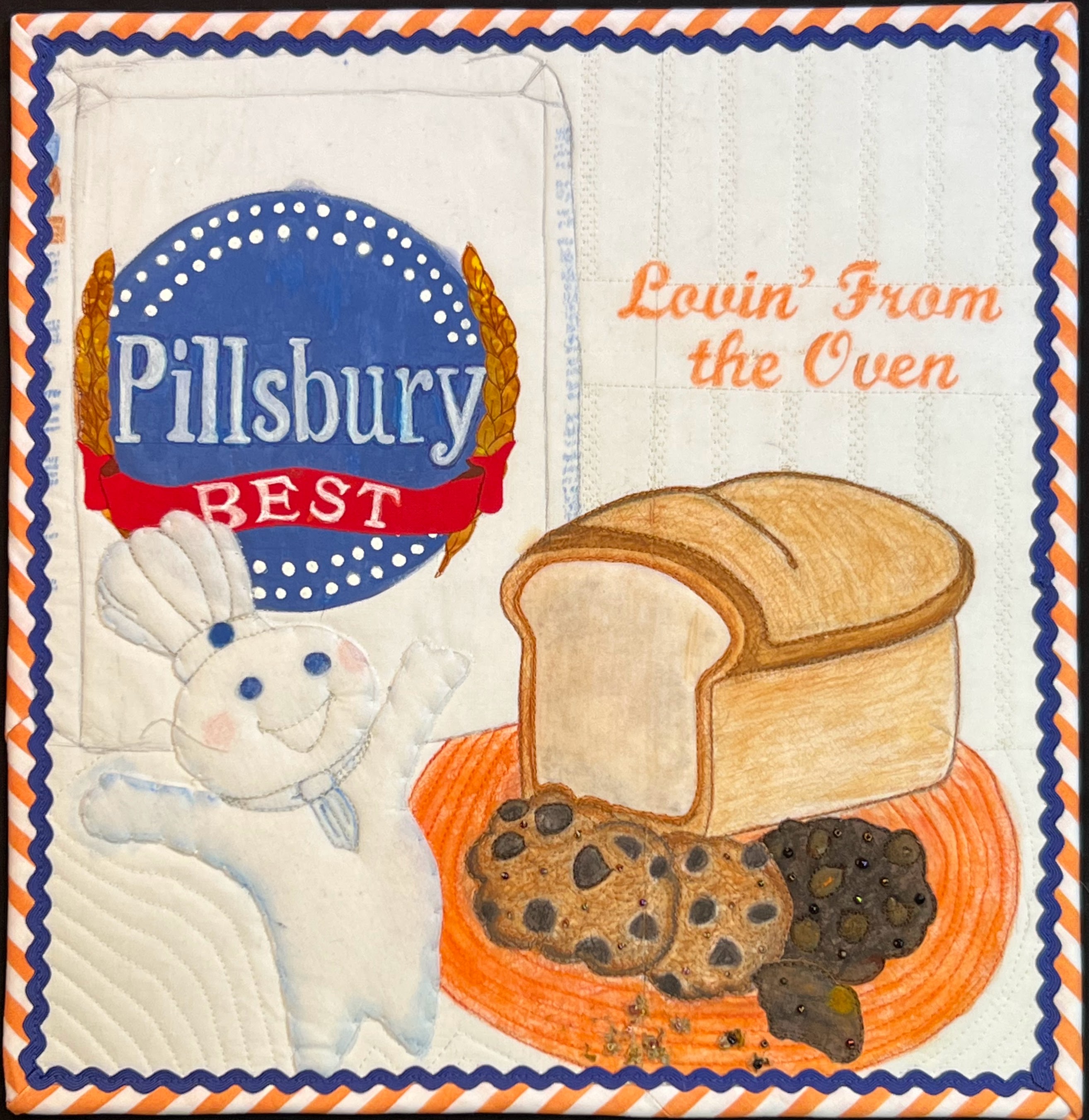
As soon as I read this joke, I knew what I would do for this challenge !!
On the first day of a marriage retreat the instructor talked about the importance of knowing what matters to each other. For example he said, pointing to my husband David, "do you know your wife's favorite flower?" David grinned and answered with confidence, "Pillsbury, All Purpose".
Here is my sixties homage to the Pillsbury dough boy and some of the goodies enjoyed by a lover of this kind of flour!!! The flour bag, plate, bread, cookies, and dough boy are hand sketched. I made a stencil for the word pillsbury and painted the circle and dots with fabric paint. The red banner and wheat are fused. The bread, cookies (painted separately and fused onto plate) and plate are colored in with Inktense pencils. The dough boy is made with two layers of very thin batting fused and stitched on and then shaded with Inktense pencils. The chocolate chips and crumbs are embellished with a few beads. Lovin' From the Oven is written with pencil and filled in with Inktense pencils. The piece is machined quilted. To complete the look I used a bias stripe and tiny ricrac in complementary colors. I had sooooo much fun working on this challenge!!
Karen's Flower- Poppies

I pulled this piece out of my class samples and re-worked it for "Flour/Flower".
I've always loved poppies though can't grow them for real!
The background is chenille, 6 layers of rayon and cotton, sliced and fluffed.
I made 2 different squares of chenille, cut an "X" through them and reattached.
The poppies are made with cotton petals and wool centers.
Double-sided with wool felt backing. and stitched onto the background using stem stitching to hold in place.
The edges are not stitched.
The poppy "bud" has a 3D center, the bottom petal is curved off the flower.
Working on this makes me want to try one more time to grow them!
Tricia’s Flower- Wisteria Tree

A year and a half ago I took a Merrill Comeau mixed media class at Snow Farm in western Mass. I started to work on a piece from a photograph of a Wisteria plant. In our last house we had a 50 year old Wisteria tree which was so beautiful in the spring. I decided to finish my piece for our flower theme.
I used raw edge appliqué, free motion stitching and French knots. I loved Merrill’s class. It helped me to free up my use of fabric.
Subscribe to:
Posts (Atom)